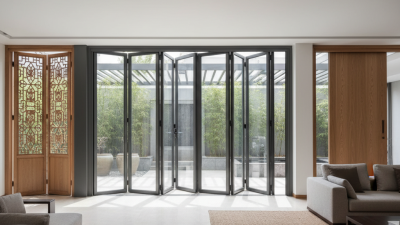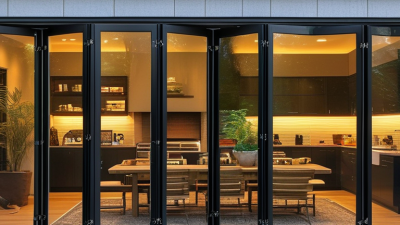
Choosing a Folding Door manufacturer in China is not just a matter of comparing prices. The right partner must turn drawings into doors that fit, slide smoothly, and hold up to daily use. Small details matter: track alignment, frame finish, hardware quality, and the way panels meet when closed. A low quotation may leave important questions unanswered.
This guide looks at manufacturers through practical criteria, including product range, customization, production experience, quality checks, and communication. It also considers whether a supplier can explain materials and specifications clearly, rather than relying on polished photos alone. Ask about sample approval, lead times, packaging, and after-sales support before making a decision. Details matter.
There is no single factory that suits every buyer. A project for a compact apartment may need different panel sizes and hardware from a hotel renovation or a commercial interior. Even a promising supplier can be a poor fit if its capabilities do not match the opening, finish, or delivery schedule. That is worth remembering.
The manufacturers discussed in this overview should be assessed against your own project requirements, not treated as a universal ranking. Verify claims directly, request current specifications, and compare like-for-like quotations. A careful review can narrow the field, though it cannot replace checking samples and confirming details with the supplier.
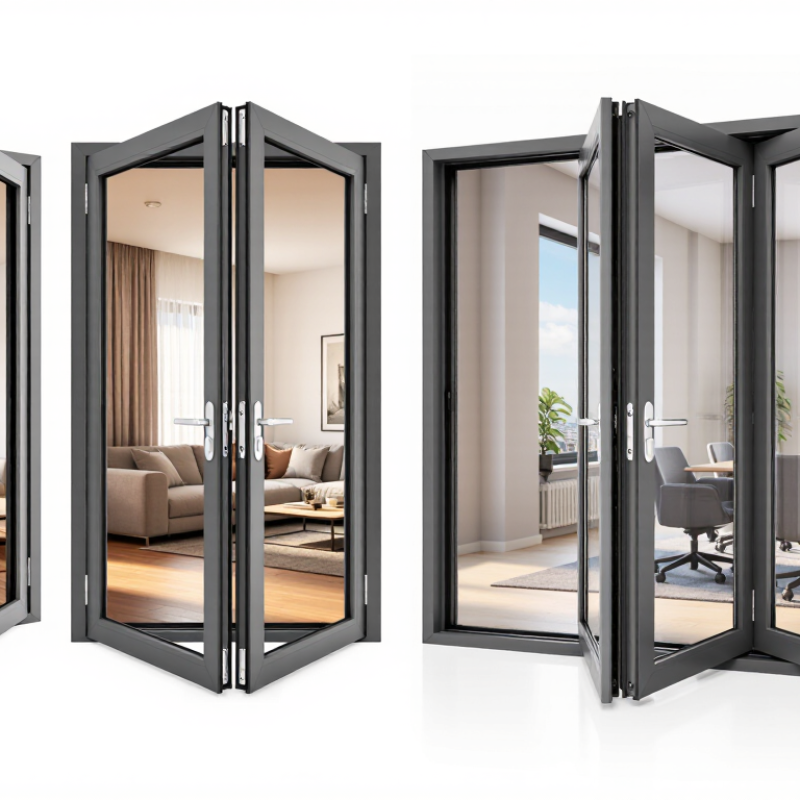
Folding doors are assemblies of linked panels, not simply wide doors with extra hinges. Each panel may use aluminum, timber, or a composite frame, with glass or opaque infill. Panel width and weight affect how smoothly the system folds. A heavy glazed panel needs compatible hinges and rollers. Details matter.
The outer frame anchors the assembly to the opening, while the track guides its movement. Top-hung systems carry much of the load above; bottom-rolling designs rely on a floor track. Check the floor level, track drainage, and fixing points before installation. A small dip can make panels rub or leave uneven gaps. It happens.
Opening layouts vary with the room and the available clearance. Panels can fold to one side, split toward both sides, or include a traffic door for everyday access. Measure the full stacking area, not just the clear opening. Also consider handles, nearby furniture, and how the panels meet at the corners. Manufacturer drawings help, but site conditions sometimes disagree with the drawing; careful measuring on location is still essential. Ask for panel dimensions, track details, and stated load limits before comparing specifications.

When comparing Chinese folding-door manufacturers, begin with evidence, not catalog claims. EN 14351-1 is a European product standard for windows and external pedestrian doorsets. A manufacturer should explain whether its specific folding-door system falls within the standard’s scope and provide relevant product documentation. Check declared performance for air permeability, water tightness, and resistance to wind load. These characteristics use separate classification standards, including EN 12207, EN 12208, and EN 12210. Ask for test reports matching the supplied system, dimensions, hardware, and glazing. A report for a different configuration may offer little practical assurance.
ISO 9001 addresses a manufacturer’s quality-management system, not the performance of an individual door. The ISO Survey of Management System Standard Certifications recorded 1,265,216 ISO 9001 certificates worldwide in 2022. That is a large number. It does not show how many door makers passed product tests, or prove that a particular factory maintains consistent quality. Verify the certificate’s validity, issuing body, covered site, and stated manufacturing scope. Then compare those details with the factory producing your order.
Useful checks are concrete: inspect production records, incoming-material controls, and final inspection criteria. Ask how the factory handles dimensional tolerances and corrective actions when a door fails inspection. Request recent, configuration-specific test evidence, not just a certificate image. Paperwork can look convincing. Still, a small gap in a test report’s scope can matter once doors face driving rain or repeated operation. Audits and certificates reduce uncertainty; they do not remove it.
EN 14351-1 and ISO 9001 address different aspects of evaluation. The chart shows which standard directly covers each area—not a manufacturer rating.
EN 14351-1 covers product performance characteristics for windows and external pedestrian doorsets. ISO 9001 specifies quality management system requirements; it is not a product-performance certification.
The best folding-door manufacturers in China should be judged by tested performance, not catalog photos alone. Ask for reports covering EN 12207 air permeability, EN 12208 watertightness, and EN 12210 wind resistance. These standards measure different risks. A door that limits drafts may still need better protection against driven rain or pressure.
Check the classification and the exact product configuration in each report. Panel size, frame design, seals, hardware, and installation can affect results. For EN 12207, compare the stated air-leakage class. For EN 12208, review the water-resistance class and test pressure. For EN 12210, check wind-load resistance and deflection. Details matter. A report for a smaller sample does not automatically prove equal performance in a wide, multi-panel opening.
Ask whether the tested system matches the proposed door, including its locking points and threshold. Request clear test dates, laboratory details, and installation guidance. Then compare the evidence with the project’s exposure: a sheltered courtyard differs from a high-rise façade facing strong winds. One imperfect reality remains: laboratory tests cannot capture every site condition. Good documentation helps, but careful installation and routine seal checks still matter.
| Performance dimension | Standard | Class or benchmark | What the classification means | What to request when comparing suppliers |
|---|---|---|---|---|
| Air permeability | EN 12207 | Classes 1–4; Class 4 is the highest classification | Rates air leakage through a tested door or window assembly under specified pressure conditions. A higher class indicates lower permitted air leakage within the standard’s classification method. | Ask for the test report showing the EN 12207 class, specimen dimensions, configuration, and tested operating arrangement. Check that the tested configuration matches the proposed folding-door system. |
| Watertightness | EN 12208 | Classes 1A–9A; Class 9A includes testing at 600 Pa. “Exxx” denotes a declared test pressure above the standard class sequence. | Classifies resistance to water penetration during a standardized test. The “A” designation is used for products exposed to conditions appropriate to that classification method. | Request the full test report and the achieved class or declared pressure. Confirm the drainage details, installation conditions, specimen size, and whether the tested threshold and panel arrangement are comparable to the project. |
| Wind resistance | EN 12210 | Classes 1–5 correspond to P1 test pressures of 400, 800, 1,200, 1,600, and 2,000 Pa respectively. Class 0 means no performance determined. | Classifies resistance to wind load using test pressure and deflection criteria. The pressure class alone does not describe every aspect of the door’s structural performance. | Request the EN 12210 report, including the pressure class, deflection class, specimen dimensions, and any relevant safety-pressure results. Have the required performance checked against the project’s exposure and design loads. |
| Wind-load deflection | EN 12210 | Classes A, B, and C: relative frontal deflection limits of 1/150, 1/200, and 1/300 respectively. | Describes the permitted relative frontal deflection under the specified test conditions. Class C is the stricter deflection limit of the three. | Compare the deflection class as well as the pressure class; ask which frame and panel arrangement was tested and whether the result applies to the supplied dimensions. |
| Test evidence and comparability | EN 12207, EN 12208, and EN 12210 | Compare reported results for the same product configuration and test basis | Classifications apply to the tested specimen and its documented configuration; results should not automatically be assumed to cover every size, threshold, glazing option, or panel layout. | Request complete, traceable test reports from a competent testing laboratory. Verify the product identification, tested dimensions, hardware, seals, glazing, installation method, and report date before making a supplier comparison. |
| Selection note | This table summarizes standard classification benchmarks; it does not rank or certify individual manufacturers. The appropriate performance target depends on the project location, building exposure, design requirements, and the exact folding-door configuration. Confirm applicable standard editions and project-specific requirements with the specifier. | |||
Who Are the Best Folding Door Manufacturers in China?
When comparing Chinese folding door manufacturers, look beyond catalog photos. Material choices affect weight, durability, and maintenance. Aluminum frames suit many wide openings, while timber offers a warmer finish but needs more care. Ask for profile thickness, hardware specifications, and finish samples you can inspect in daylight.
Product range matters, too. Some factories focus on interior partitions; others make exterior systems with insulated glass, weather seals, and drainage details. Check how panels fold and stack, then ask about opening width, track design, and replacement parts. Small details matter. A smooth showroom sample may not reveal how a door performs after repeated daily use.
Production capacity should be verified, not assumed from a large factory floor. Request recent lead-time estimates, quality-control steps, and details about sample approval and packing. If possible, review a production run or speak with existing buyers. A neat brochure is useful, but it is not proof. I would also leave room for uncertainty: advertised capacity can change with order size, season, and custom specifications. Compare the same product requirements across suppliers before judging price or delivery promises.
When reviewing a folding door manufacturer’s test data, check the full report, not just a certificate or a pass statement. ASTM E283 measures air leakage at stated pressure differences. Look for the tested door’s dimensions, panel layout, seals, hardware, and reported leakage rate. These details matter: a narrow sample with fewer panels may not represent a wide, multi-panel system. Ask whether the tested configuration matches the product being quoted.
ASTM E330 evaluates structural performance under uniform static pressure, while ASTM E547 assesses water penetration under cyclic pressure. Check the pressure levels, test duration, observed deflection, and any water entry noted in the report. Then confirm the report number, issuing laboratory, and whether its accreditation covers the relevant test methods. Keep the installation in view. A laboratory result does not guarantee the same performance with poor anchoring, uneven thresholds, or incorrect sealing on site. Even a neat report can leave questions. If sample details or test conditions are missing, ask for clarification before comparing products; the paperwork may be incomplete, and that deserves a closer look.